


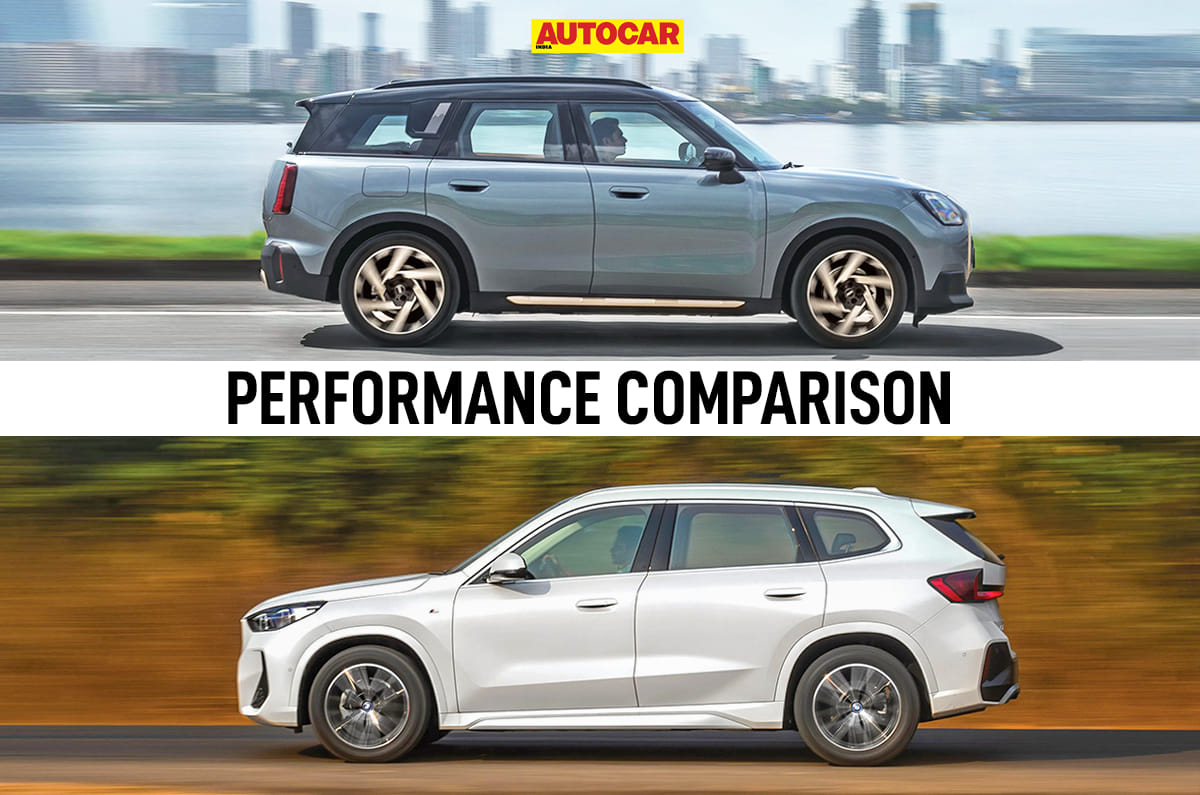
Among the entry-level luxury EVs, the BMW iX1 LWB and Mini Countryman Electric share a lot. Both eSUVs are powered by a 66.4kWh battery and come with a front-axle-mounted motor that produces 204hp and 250Nm. In fact, these EVs are based on the BMW Group’s FAAR (Frontantriebsarchitektur) platform and can be considered badge-engineered twins, so much so that the BMW and Mini have an identical claimed 0-100kph time of 8.6 seconds. We find out which offers more real-world performance, the BMW iX1 eDrive20L or the Mini Countryman Electric.
BMW iX1 LWB vs Mini Countryman Electric: Specifications and price
iX1 LWB is heavier than the Countryman E, but the BMW has a higher claimed top speed.
|
|
iX1 eDrive20L |
Countryman E |
|
Battery size (kWh) |
66.4 |
66.4 |
|
Electric motor setup |
Single motor, front |
Single motor, front |
|
Power (hp) |
204 |
204 |
|
Torque (Nm) |
250 |
250 |
|
Kerb weight (kg) |
1948 |
1940 |
|
Power-to-weight (hp/tonne) |
104.72 |
105.15 |
|
Torque-to-weight (Nm/tonne) |
128.34 |
128.87 |
|
Claimed 0-100kph (seconds) |
8.6 |
8.6 |
|
Claimed top speed |
175 |
170 |
|
Range (km) |
531 (MIDC) |
462 (WLTP) |
|
Price (Rs, lakh) |
49.90 |
54.90-59.95 |
Prices are ex-showroom, India, as on December 31, 2025.
While battery and motor specifications of the iX1 LWB and Countryman E are identical, the BMW weighs 8kg more than the Mini, which puts the power- and torque-to-weight ratios in the latter’s favour. The iX1 LWB is larger overall – 171mm in length, 108mm in the wheelbase and 2mm in width – than the Countryman, but its height is 8mm less. Its claimed top speed is 5kph higher as well. Do note that the iX1 LWB costs at least Rs 5 lakh less than the Countryman E. The range figures are not comparable as the iX1 LWB is rated as per the Modified Indian Driving Cycle (MIDC), while the Countryman Electric’s number is as per the European Worldwide Harmonized Light Vehicle Test Procedure (WLTP).
BMW iX1 LWB vs Mini Countryman Electric: 0-100kph acceleration tests
Countryman E is quicker to 60kph, but iX1 LWB is quicker to 100kph.
| 0-100kph acceleration (seconds) | iX1 eDrive20L | Countryman E |
| 0-20kph | 1.73 | 1.47 |
| 0-40kph | 3.12 | 2.97 |
| 0-60kph | 4.53 | 4.49 |
| 0-80kph | 6.22 | 6.37 |
| 0-100kph | 8.34 | 8.91 |
| 0-120kph | 11.30 | 12.19 |
| 0-140kph | 15.20 | 16.45 |
In our 0-100kph acceleration tests, the Mini Countryman Electric takes the lead initially and maintains it until 60kph with a 0.04-second margin. However, the iX1 LWB pulls ahead after that, reaching 100kph 0.57 seconds quicker. Essentially, this means that the iX1 LWB is 0.26 seconds quicker than BMW’s claimed 0-100kph time, while the Countryman E is 0.31 seconds slower than Mini’s claim. By the time 140kph arrives on our GPS-based timing equipment, the BMW pulls 1.25 seconds ahead of the Mini.
BMW iX1 LWB vs Mini Countryman Electric: Rolling acceleration tests
BMW is marginally quicker in both 20-80kph and 40-100kph acceleration tests.
| Rolling acceleration tests (seconds) | iX1 eDrive20L | Countryman E |
| 20-80kph (in kickdown) | 4.83 | 4.87 |
| 40-100kph (in kickdown) | 5.72 | 6.32 |
The iX1 LWB maintains its lead by edging ahead of the Mini in our rolling acceleration tests. It was 0.04 seconds and 0.6 seconds quicker in the 20-80kph and 40-100kph runs, underlining its status as the eSUV that offers more performance.
BMW iX1 LWB vs Mini Countryman Electric: Braking tests
In the 80-0kph test, Countryman E stops 2.11 metres short of the iX1 LWB.
| Braking tests | iX1 eDrive20L | Countryman E |
| 80-0kph distance (m) | 26.48 | 24.37 |
| 80-0kph time (s) | 2.37 | 2.53 |
| 80-20kph L1 regen distance (m) | 373.8 | 379.21 |
| 80-20kph L2 regen distance (m) | 183.88 | 192.18 |
| 80-20kph L3 regen distance (m) | 48.13 | 144.68 |
The Countryman Electric manages to out-brake the iX1 LWB from 80-0kph in terms of distance, taking 2.11 metres less; the BMW takes 0.16 seconds less, though. The iX1 LWB’s regenerative braking system is also the stronger of the two, and in Level 3 (the highest level of regen), it slows from 80kph to 20kph in just 48.13 metres, compared to 144.68 metres for the Mini.
Autocar India’s testing standards
Before we conduct our performance tests, we check and maintain tyre pressure based on the manufacturer’s recommendation and ensure the car is charged to 100 percent. The car is then tested in a controlled environment with two people on board, and the data is collected via highly accurate GPS-based timing equipment.