


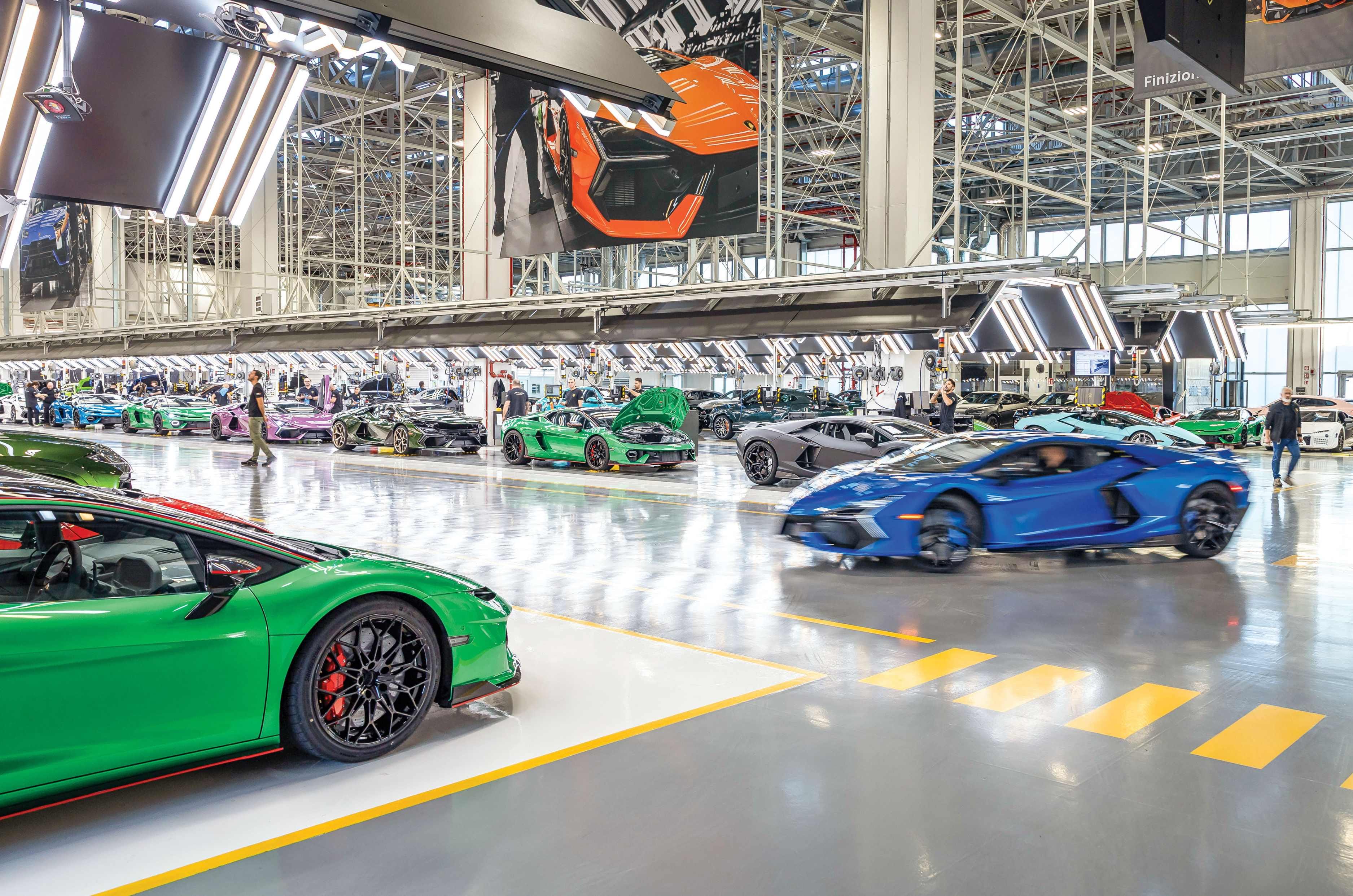
The angular silhouette of Lamborghini’s headquarters rises from the Emilia-Romagna countryside like a fortress of speed. I am here for a visit to see how a supercar is built, but it feels more like a pilgrimage. This manufacturing plant in Sant’Agata Bolognese in Italy is not merely a car factory. It is a cathedral. Here, carbon fibre undergoes its rites of passage, and combustion becomes communion. This is the nerve centre of Automobili Lamborghini.
As I pass through the gates, the same gates where Ferruccio Lamborghini once stormed in to prove Enzo Ferrari wrong, the weight of automotive history settles. My guide, a production engineer with 15 years here, whom I shall call Alessandro, greets me with a knowing smile. “You’ve arrived at an interesting moment. We’re building the future while honouring the past.”
The carbon cathedral
The tour begins in the CFK (Carbon Fibre Komposit) plant, a climate-controlled sanctum where temperature and humidity are monitored more carefully than in a hospital’s operating theatre. The air smells sweet and chemical, that of prepreg carbon fibre awaiting transformation.
The Monofuselage chassis of the Revuelto hangs before us like a skeletal sculpture. Unlike the Aventador’s carbon tub with its bolted aluminium front frame, the Revuelto’s monocoque integrates everything, cockpit, structural floor and crash box, into one seamless piece. “It weighs less than a man, but it’s stiffer than anything we’ve ever built,” Alessandro says, knocking on the chassis. The sound is sharp, musical. “Twenty five percent improvement in torsional rigidity. That’s revolution.”
The construction employs Lamborghini’s proprietary Forged Composite technology for high-stress areas: chopped carbon fibres moulded under extreme heat and pressure, creating complex geometries impossible with traditional layup methods. The result eliminates joints and weak points entirely. Combined with aerospace-grade prepreg for the main structure, this hybrid approach achieves high rigidity-to-weight ratios.
The numbers are staggering: 572hp/tonne power-to-weight ratio, the best in Lamborghini history. This 1,014hp hybrid weighs 1,772kg (dry weight) – about the same as a BMW M3, and produces almost double the power. “When you turn into a corner at 200kph, every millimetre of input is transmitted directly, immediately,” Alessandro continues. “The chassis doesn’t flex, doesn’t hesitate. It just obeys.”
The robot ballet
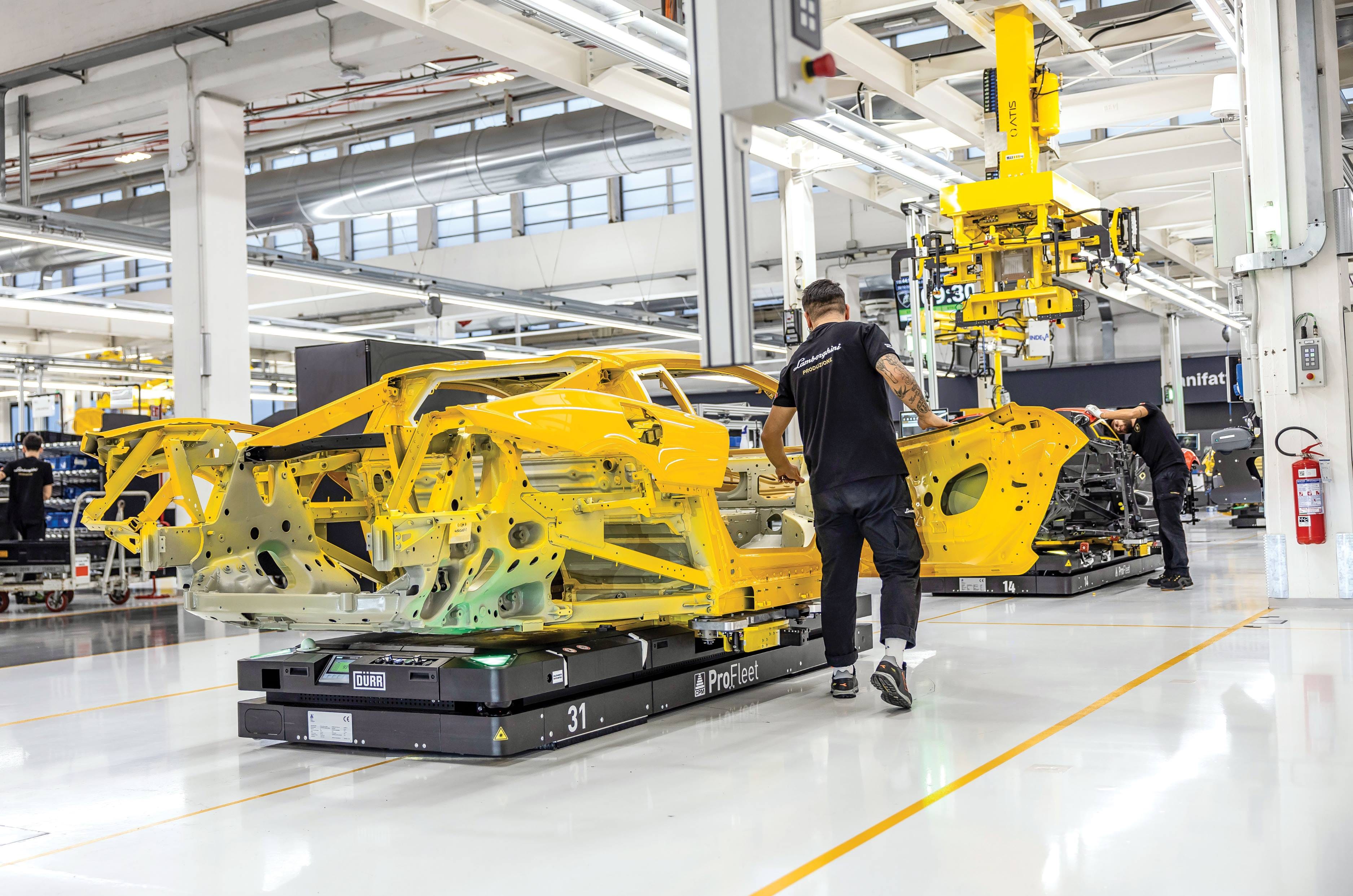
On the main production floor, there’s no traditional assembly line. Instead, vehicles glide between stations on Automated Guided Vehicles (AGVs) like a carefully choreographed dance.
“Welcome to Factory 4.0,” Alessandro announces. “These AGVs navigate autonomously between our 15 specialised stations. We can build a V12 Revuelto and a V8 Temerario on the same line, switching between completely different architectures without stopping production.”
At each station, technicians consult touchscreen displays. This is the electronic Vehicle Data Card showing exact specifications. A technician mounts an electric motor to the front axle. His digital torque wrench flashes green: 47.3 Newton metres. Approved. The system monitors every bolt in real time.
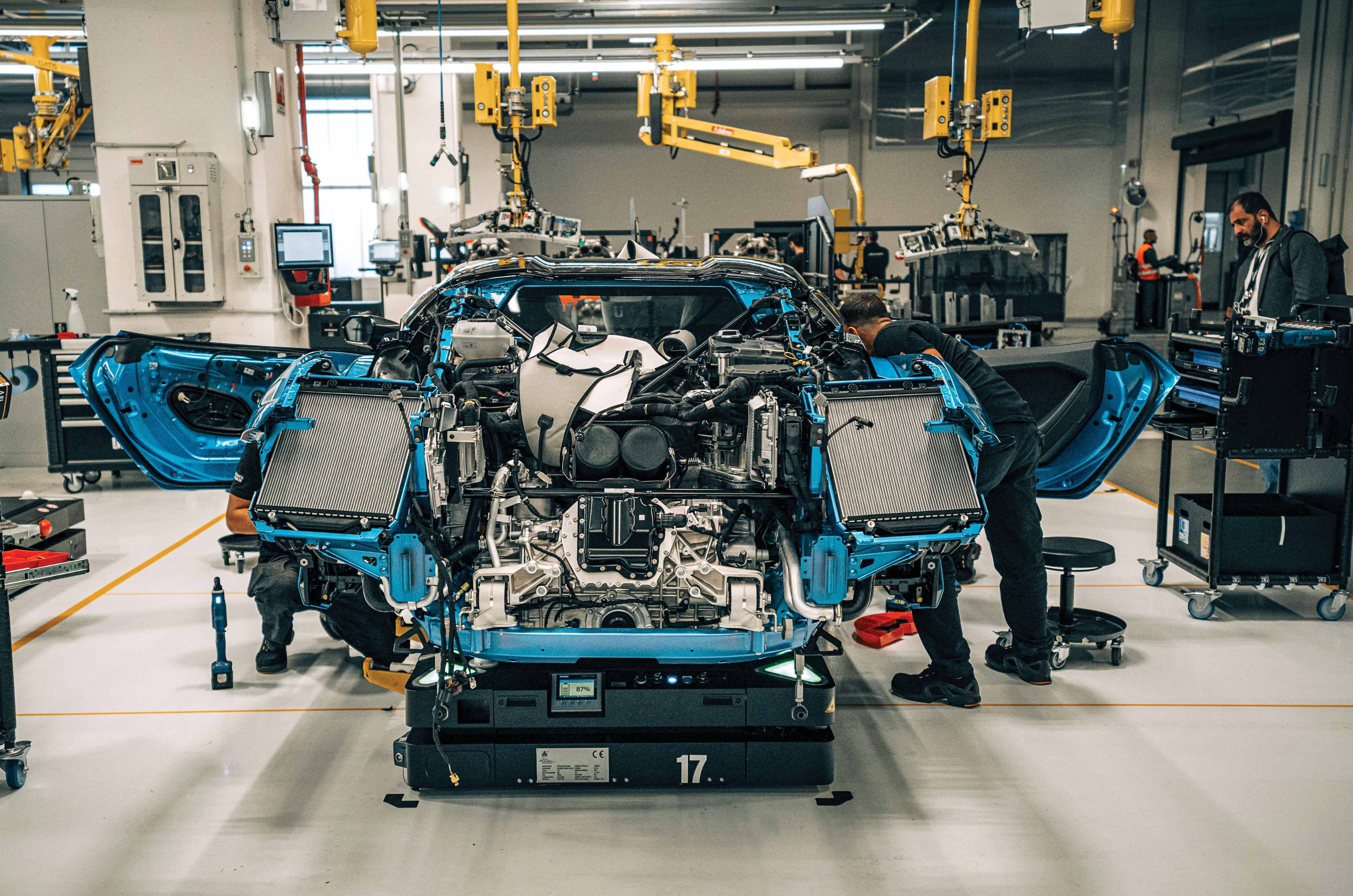
“Zero tolerance,” Alessandro says. “These e-motors produce instant torque. If a mounting bolt fails at full power, it would be catastrophic. So, we measure everything.”
The modular approach extends to the entire powertrain. The Revuelto’s three electric motors, two 110kW axial-flux units up front and a 110kW radial-flux unit integrated into the transmission, are pre-assembled with their inverters and cooling systems as complete modules. This allows parallel assembly and comprehensive bench testing before integration, dramatically reducing line time while improving quality control.
Where silicon meets soul
Despite the digital infrastructure, humans are everywhere, working side-by-side with collaborative robots (cobots). Humans are not just supervising robots but actively involved in building. I had expected more automation, but the heart of a Lamborghini still beats in human hands, enhanced by cobots that assist precision tasks and ensure quality without replacing human craftsmanship.
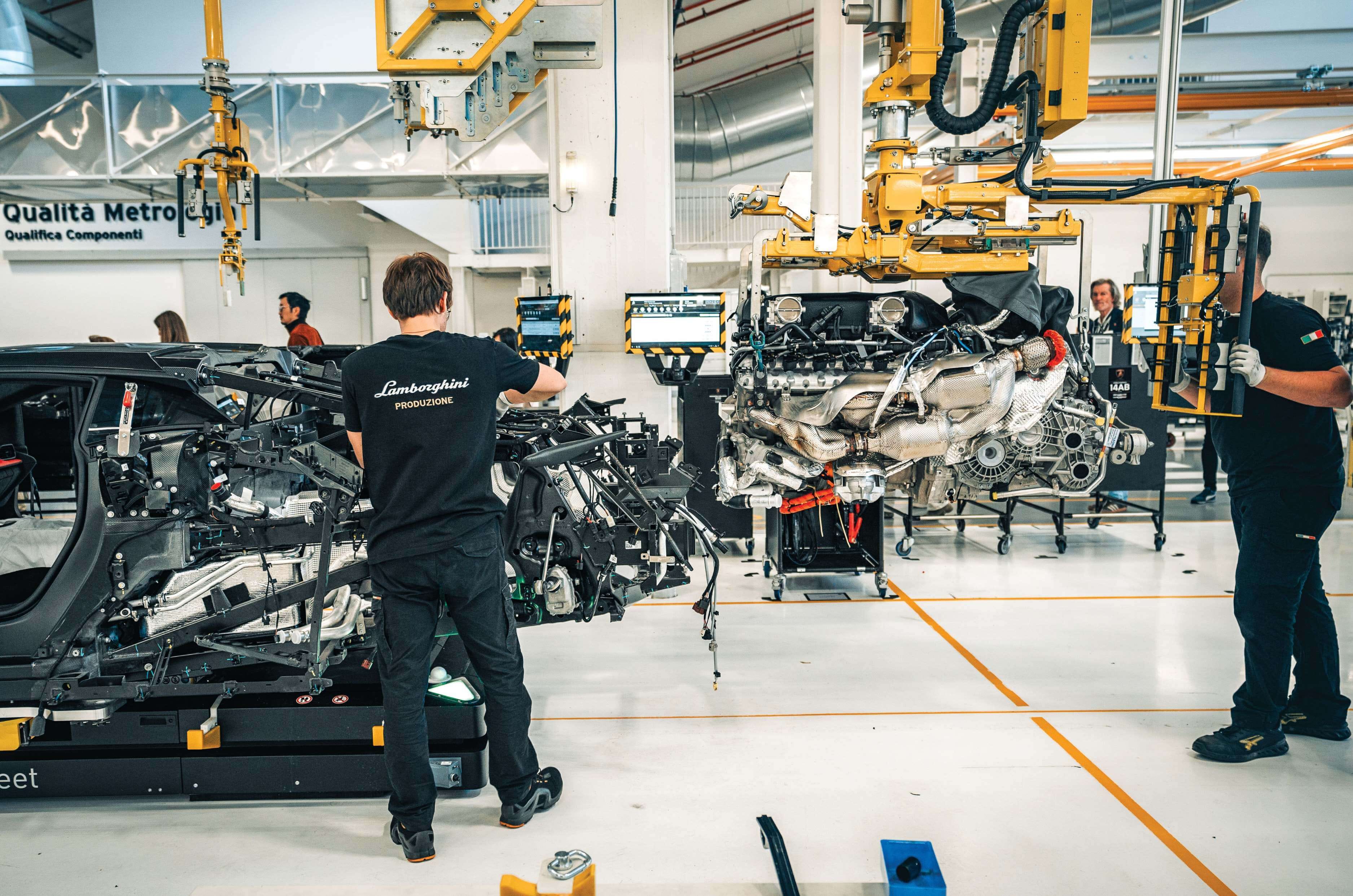
We stop at the engine assembly area. Here, a master technician, let’s call him Giovanni, hunches over a Revuelto L545 V12, his hands moving with surgical precision.

“Giovanni has been building V12s for 22 years,” Alessandro whispers. “Every Revuelto engine, each an 814-horsepower beast, is assembled entirely by one person. From dry-sump lubrication to final head gasket sealing. One pair of hands.”
This handcrafted approach ensures exceptional quality and attention to detail, reflecting Lamborghini’s commitment to artisanal craftsmanship despite the advanced technology present in the factory. The single-assembler tradition underlines that while automation exists, the heart of the Revuelto is still brought to life by one pair of expert hands.

Giovanni carefully torques down a valve cover, pausing to feel the resistance, to listen for the subtle click. “The engine is the soul,” he says without looking up. “When the customer hears that 9,250rpm peak-power scream, they will know someone cared. Not a machine. Me.”
In the dyno room, a freshly assembled V12 undergoes its first fire-up. Giovanni presses the starter button. The V12 coughs, catches, settles into a lumpy idle. Then the technician opens the throttle.
The sound is apocalyptic. The naturally aspirated V12 screams toward its 9,500rpm redline with fury that seems to tear at reality. It’s visceral, emotional, somewhere between fury and ecstasy. When the test ends, Giovanni finally smiles. “Perfect. Next.”
The electrified evolution
Alessandro addresses the elephant in the room, the battery pack. “Electrification! Is Lamborghini going soft?” He leads me to a powertrain schematic. “This isn’t compromise. This is amplification.” The 6.5-litre V12 makes 814hp alone, already more than any production V12 they’ve built. Three electric motors add another 187hp for a total of 1,001 horsepower. The system delivers instantaneous torque vectoring, true electric AWD and in Città mode, you can cruise through Milan in silence using just the front motors.
The Lamborghini Revuelto features a 3.8kWh lithium-ion battery pack ingeniously nestled in the transmission tunnel to optimise weight distribution. Unlike many traditional plug-in hybrids that lose electric assist as the battery depletes, the Revuelto’s energy management system keeps the battery sufficiently charged, for peak electric motor performance, at all times. Regenerative braking and the V12’s integrated starter-generator continuously recharge the battery during driving, ensuring the full combined system output is always available on demand. This supports instant torque vectoring and electric AWD without performance compromise.
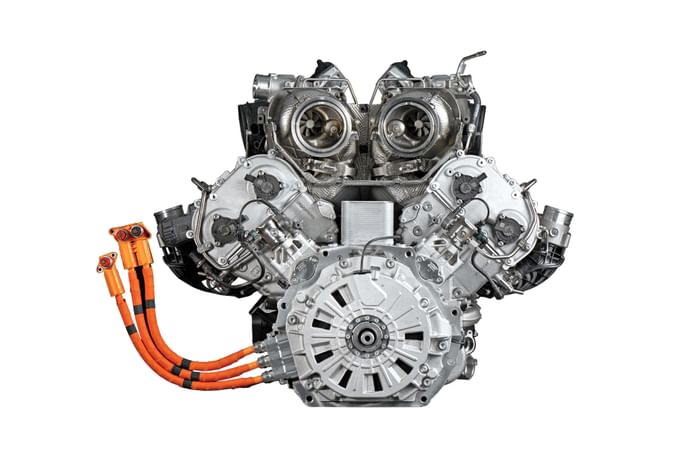
But the real marvel is the ‘little’ Temerario’s V8. Four litres, twin-turbo, 920 total horsepower, revving to an absurd 10,000rpm. “How do you make a forced-induction V8 feel and sound like a naturally-aspirated engine?” Alessandro asks. The engineering is obscene in its precision: billet crankshaft, titanium connecting rods, aerospace-grade valvetrain. Turbos positioned to minimise lag while letting it breathe at high rpm.
The valvetrain employs Hydraulic Lash Adjusters (HLA) with ultra-low friction finger followers, reducing reciprocating mass to levels typically seen only in race engines. The twin-scroll turbochargers are mounted in a hot-vee configuration, minimising exhaust runner length for sharper throttle response. Peak boost is controlled electronically to ensure linear power delivery throughout the rev range, eliminating the traditional forced-induction surge.
“The acoustic team spent months tuning exhaust geometry, resonance chambers and bypass valves. This V8 must sound like Sant’Agata. Raw. Mechanical. Aggressive. Pura emozione.”
The final touch
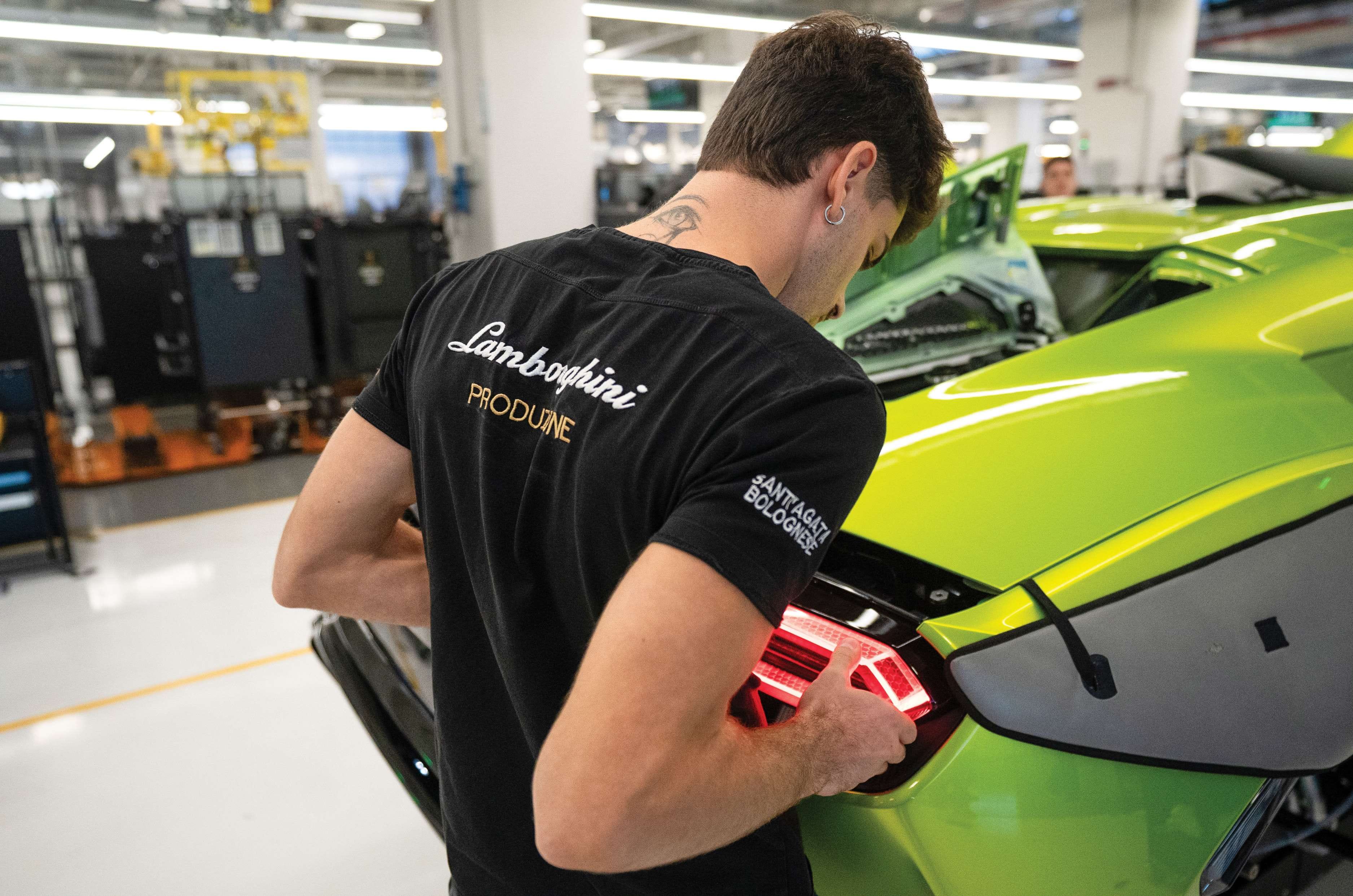
The last stop is interior assembly, where the pace slows to something meditative. A specialist, christened for this page as Francesca, assembles a Revuelto cockpit in Nero Cosmus leather with Arancio Dryope contrast stitching – black and orange, classic Lamborghini.
“The cockpit is inspired by a fighter jet,” she explains, hands never stopping. “Clean. Symmetrical. Driver-focused. But it must feel Italian, warm, luxurious and alive.”

She uses a laser cutter for perfect symmetry, but final stitching is done by a human-operated sewing machine. “Through the Ad Personam program, customers specify everything. No two are the same. This is why it must be done by hand. A robot follows instructions. I interpret them. I bring them to life.”
At final assembly, a completed Revuelto in Giallo Auge is lowered off its AGV. The wheels touch the floor. The engine bay closes. The doors shut with a satisfying thunk. It’s alive. “This is the contradiction,” Alessandro says. “The most advanced manufacturing technology in the world, married to the oldest tradition in Italian craftsmanship. Industry 4.0 meets centuries-old dedication. It’s the only way to build a Lamborghini.”
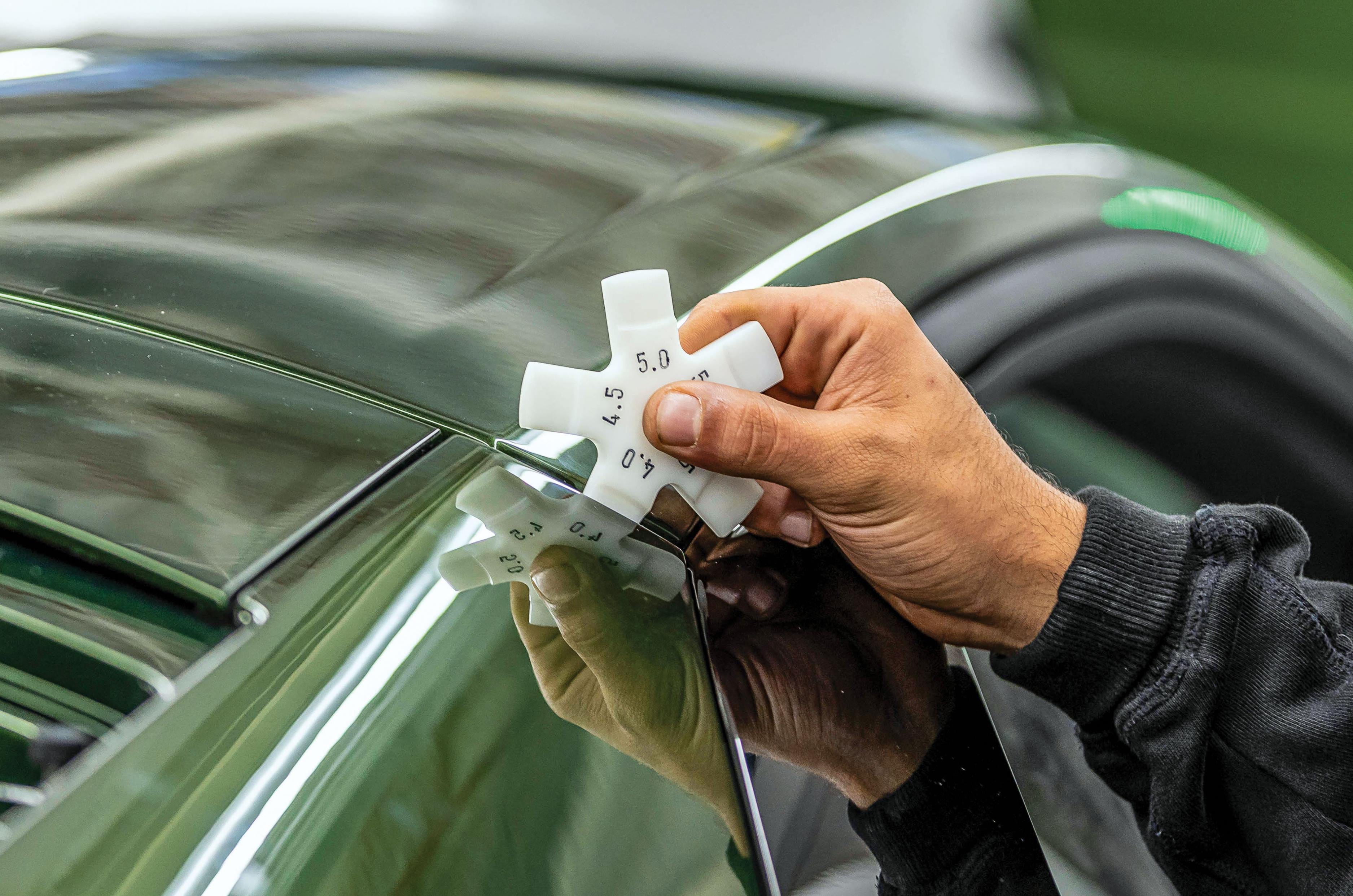
As I leave Sant’Agata, I’m struck by a realisation: Lamborghini hasn’t abandoned its soul in pursuit of electrification. It has amplified it. The V12 still screams to 9,250rpm. The V8 to 10,000. The carbon fibre is stiffer and lighter than ever. Digital systems ensure perfection in ways humans alone never could. Yet at every critical moment, engine assembly, interior stitching, final quality check, there are human hands, human eyes and human judgment.
To stand on that factory floor is to witness a beautiful contradiction: the seamless fusion of silicon and soul, of algorithms and artistry. It proves that even in the age of electrification, the heart of the Raging Bull remains fiercely, thrillingly alive. And it beats louder than ever.