


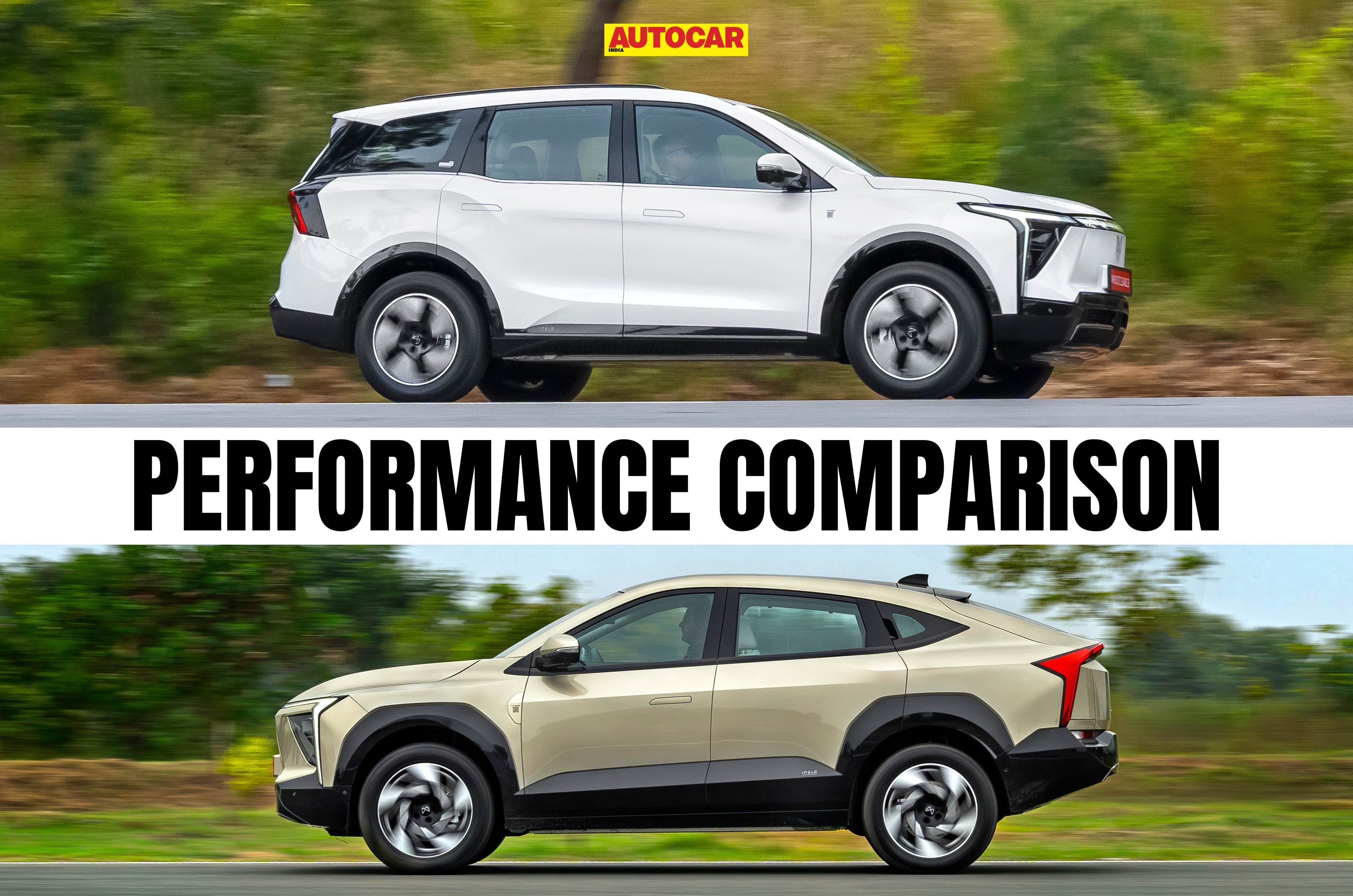
Mahindra’s flagship EVs, the three-row XEV 9S SUV and the XEV 9e coupe-SUV, share the brand’s INGLO platform, and their respective range-topping variants have the same 79kWh battery and 286hp rear motor. We dig through our extensive performance data to see which electric SUV offers more real-world performance in terms of acceleration and braking with our exhaustive and accurate tests.
Mahindra XEV 9S vs XEV 9e: Specifications and price
XEV 9S Pack Three Above is claimed to be 0.2 seconds slower to 100kph but has 23km more ARAI range.
| Specifications & price | XEV 9s Pack Three Above | XEV 9e Pack Three |
| Battery size (kWh) | 79 | 79 |
| Electric motor setup | Single motor, rear | Single motor, rear |
| Power (hp) | 286 | 286 |
| Torque (Nm) | 380 | 380 |
| Gearbox | Single-speed automatic | Single-speed automatic |
| Kerb weight (kg) | NA | 2,201 |
| Power-to-weight (hp/tonne) | NA | 129.94 |
| Torque-to-weight (Nm/tonne) | NA | 172.65 |
| Claimed 0-100kph (seconds) | 7 | 6.8 |
| MIDC range (km) | 679 | 656 |
| Price (Rs, lakh) | 29.45^ | 30.50*^ |
*7.2kW AC charger costs Rs 50,000
^11.2kW AC charger costs Rs 75,000
As mentioned above, the top-spec XEV 9S Pack Three Above and XEV 9e Pack Three trims share the battery and motor, though the crucial difference comes in the form of weight. Mahindra has confirmed the XEV 9S is the heavier of the two, though it has yet to divulge the actual kerb weight figure. This affects the claimed 0-100kph as the XEV 9e is 0.2 seconds quicker. It should also be noted that the 7-seat XEV 9S costs over Rs 1 lakh less than the XEV 9e coupe and has a 23km higher ARAI range.
Mahindra XEV 9S vs XEV 9e: 0-100kph acceleration test
XEV 9S quicker until 40kph, but XEV 9e edges ahead after
| 0-100kph acceleration (seconds) | XEV 9s Pack Three Above | XEV 9e Pack Three |
| 0-20kph | 1.39 | 1.42 |
| 0-40kph | 2.73 | 2.78 |
| 0-60kph | 4.17 | 4.14 |
| 0-80kph | 5.62 | 5.59 |
| 0-100kph | 7.54 | 7.45 |
| 0-120kph | 9.98 | 9.86 |
| 0-140kph | 13.35 | 13.10 |
The three-row 9S is marginally quicker off the line than the 9e coupe, arriving at the 40kph mark 0.05 seconds quicker. However, the XEV 9e takes the lead from there, and when 100kph, 120kph and 140kph show up on our GPS-based testing equipment, the coupe increases its lead by 0.09 seconds, 0.12 seconds and 0.25 seconds, respectively. Both e SUVs have a claimed top speed of 202kph.
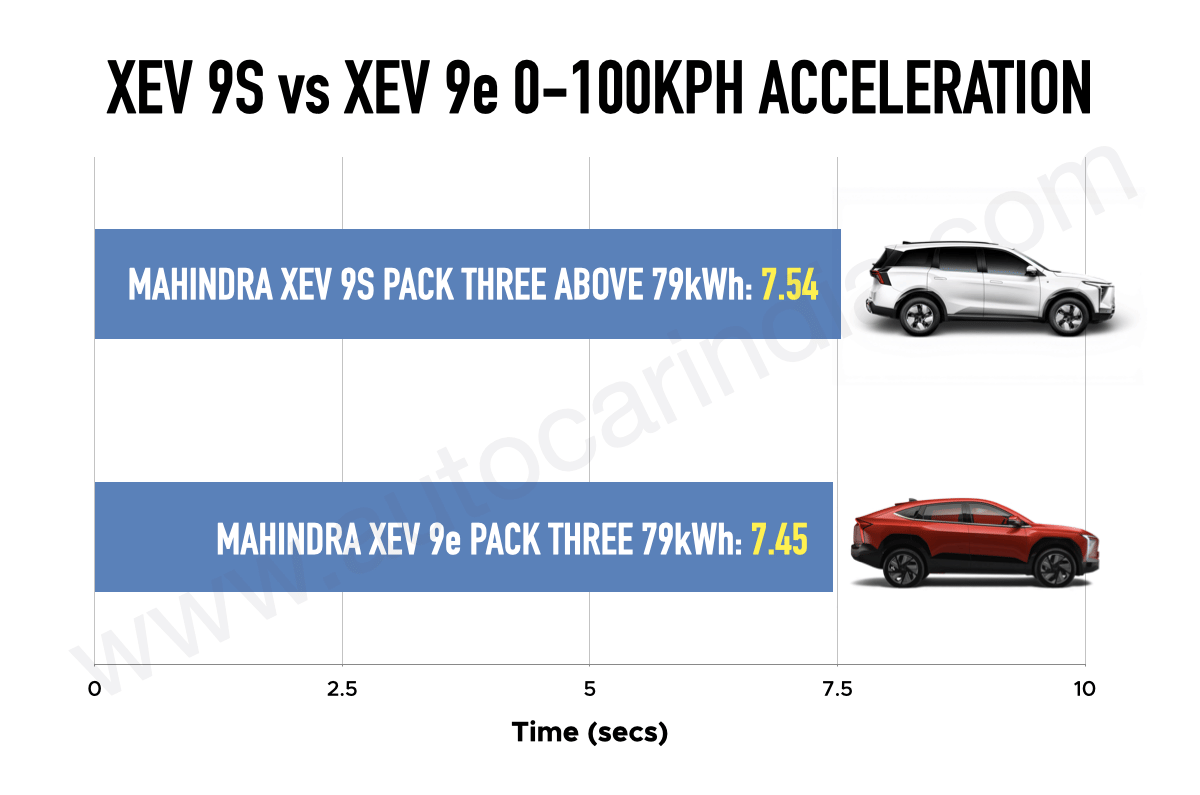
It should be noted that the XEV 9S clocked its quickest time in the performance-oriented drive mode, Race, while the XEV 9e’s quickest 0-100kph time came in the standard Everyday drive mode, though with the Boost function enabled. Both SUVs also get an Eco drive mode, which is noticeably slower than the other two.
Mahindra XEV 9S vs XEV 9e: Rolling acceleration tests
XEV 9S is quicker in the 20-80kph run, but XEV 9e is faster from 40-100kph
| Rolling acceleration tests (seconds) | XEV 9s Pack Three Above | XEV 9e Pack Three |
| 20-80kph (in kickdown) | 4.11 | 4.17 |
| 40-100kph (in kickdown) | 4.74 | 4.61 |
Interestingly, the difference in weight has a negligible effect in our rolling acceleration tests. The XEV 9S was 0.06 seconds slower in the 20-80kph run, while the XEV 9e was 0.13 seconds slower in the 40-100kph sprint.

In terms of overall acceleration performance, the XEV 9S is slower than the 9e, but the coupe-SUV is only ahead of the 7-seat SUV by marginal amounts.
Mahindra XEV 9S vs XEV 9e: Braking test
Heavier XEV 9S has a longer braking distance
| Braking tests | XEV 9S Pack Three Above | XEV 9e Pack Three |
| 80-0kph distance (m) | 29.67 | 25.88 |
| 80-0kph t ime (s) | 2.55 | 2.64 |
| 80-20kph L1 regen distance (m) | 341.03 | 297.24 |
| 80-20kph L2 regen distance (m) | 215.8 | 174.51 |
| 80-20kph L3 regen distance (m) | 162.46 | 134.95 |
Both EVs come with a similar braking setup, but the three-row XEV 9S’s higher weight figure plays a role in the 80-0kph braking and 80-20kph regen tests. The XEV 9e coupe outbrakes the XEV 9S consistently, including in all three regenerative brake modes. It should be noted that both also come with a single-pedal regen mode that allows the Mahindra EVs to come to a halt without using the brake pedal.
Autocar India’s testing standards
Before we conduct our performance tests, we check and maintain tyre pressure based on the manufacturer’s recommendation and ensure the car is charged to 100 percent. The car is then tested in a controlled environment with two people on board, and the data is collected via highly accurate GPS-based timing equipment.
All prices are ex-showroom, India.