


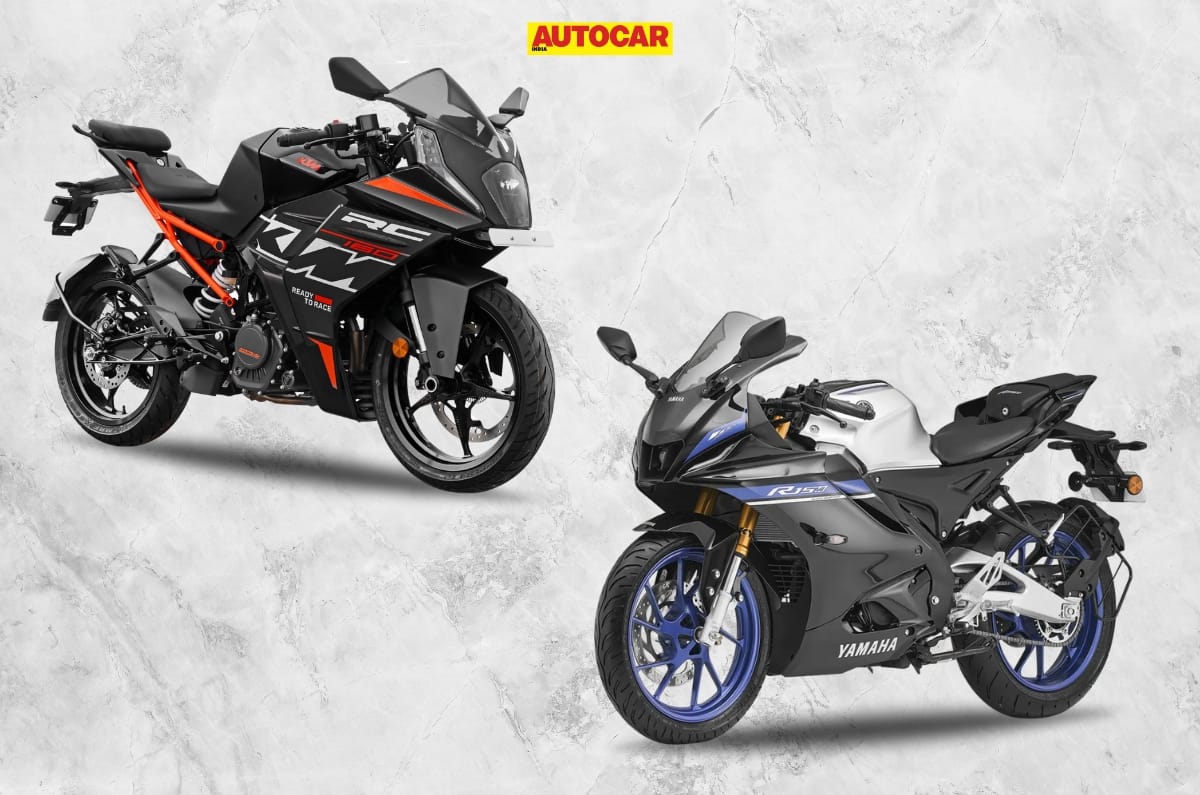
KTM has launched the RC 160, which is essentially the 160 Duke’s engine wrapped in the RC 200’s fairing. This results in a sporty rider’s triangle and makes it the entry point to KTM’s RC family, replacing the earlier RC 125. Here’s how KTM’s smallest supersport stacks up against its chief rival on paper.
KTM RC 160 vs Yamaha R15 Engine and output
The KTM produces higher peak output, but the R15 has a better power-to-weight ratio.
The smallest RC in KTM’s portfolio has been the RC 125. However, it could never match the outright grunt of the R15, owing to its larger-displacement engine and higher peak output. With the introduction of the RC 160, KTM has addressed this shortcoming. The RC 160 is now better positioned to take on the R15, offering higher peak power and torque, though it has a lower power-to-weight ratio due to its heavier kerb weight. Both the RC 160 and the R15 produce peak torque at identical RPMs, but the RC 160 makes peak power slightly lower in the rev band.
KTM RC 160 vs Yamaha R15: Weight and dimensions
The RC 160 is 14kg heavier than the R15.
The R15 benefits from a lower kerb weight, with the RC 160 being 14kg heavier. While the RC 160 does offer a higher fuel-carrying capacity, it tips the scales at 155kg, making it 8kg heavier than the 160 Duke. The R15 also has a seat height that is 15mm lower, which should help shorter riders, especially since the overall rider’s triangle on both bikes is quite committed.
KTM RC 160 vs Yamaha R15: Tyres, suspension and brakes
Both motorcycles get a radial rear tyre.
Both the Yamaha and the KTM run similar tyres, with an MRF Zapper up front and an MRF Revz radial at the rear. The KTM, however, gets a wider front tyre as well as a larger front disc, which is in line with the RC 160’s higher kerb weight.
KTM RC 160 vs Yamaha R15: Features
The top-spec R15M features a TFT dash.
The Yamaha R15 is available in multiple variants. The R15 V4 features an LCD dash, and the white colour option also offers a quickshifter as an accessory. That said, the LCD dash does provide Bluetooth connectivity. Moving up the R15 range, and spending a bit more, gets you the top-spec R15M, which comes with a TFT dash featuring an R1M-inspired layout. The ‘M’ variant also includes a quickshifter as standard.
In contrast, the RC 160 is offered in a single variant and misses out on a TFT dash – something the 160 Duke recently received as a variant option – instead making do with an LCD unit with Bluetooth connectivity. It gets switchable rear ABS, and both bikes also come equipped with a slipper clutch. LED headlights and tail-lights are standard on both motorcycles.
KTM RC 160 vs Yamaha R15: Price
The R15 has a lower base price.
The RC 160 is priced higher than even the top-spec R15M. The price referenced here for the R15M is the ‘Icon Performance’ variant, which costs Rs 10,000 more for the paint scheme, but is otherwise identical to the standard R15M priced at Rs 1.81 lakh. At the lower end of the range, the base R15 V4 is significantly more affordable and delivers the complete R15 package, barring a few features such as a TFT display and a quickshifter. Even with the quickshifter added, the R15 still comes in at around Rs 1.70 lakh. At its current pricing, the RC 160 carries a substantial premium over its chief rival, the R15.